
Guides · 7 min read
Traditional Indian board games: rules and home versions
Long before screens, families in India played on boards scratched into floors, drawn in chalk on a courtyard or carved into a wooden plank. Many of these games need nothing more than a few lines and a handful of seeds, stones or shells.
This guide covers six traditional games that you can also play on GoKith. For each one you will find a little background, the basic rules and a way to make your own set. Rules for old games often vary from region to region and even from family to family, so treat these as a good starting point rather than the only correct version.
Bagh-Chal: tigers and goats
Bagh-Chal is a hunt game most closely linked with Nepal, where it is very widely played. Similar tiger-and-goat games are known in many parts of India, such as Aadu Puli Attam in Tamil Nadu. One player has 4 tigers and the other has 20 goats.
To make a board, draw a square and divide it into a 4 by 4 grid of smaller squares, so there are 25 points where the lines cross. Then draw both long diagonals of the big square, and a diamond joining the middle points of its four sides. Pieces sit on the points, not inside the squares. Use 4 large stones or bottle tops for tigers and 20 small seeds or buttons for goats.
- The tigers start on the four corner points. In the version most often described, the goat player goes first.
- Goats enter one at a time on any empty point. Goats may not move until all 20 are on the board.
- On their turn, a tiger moves one step along a line to an empty point, or jumps over a single goat in a straight line to the empty point just beyond it. The jumped goat is captured and removed. Tigers may capture while goats are still being placed.
- Goats can never jump or capture. Once all are placed, a goat moves one step along a line to an empty point.
- The tigers win by capturing 5 goats. The goats win when no tiger can move.
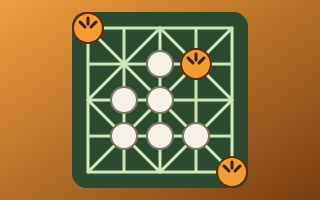 Bagh-Chal: Tigers & Goats
Navakankari: making mills
Navakankari is an Indian name for the game many people know as nine men's morris. Nava means nine in many Indian languages. Boards for morris games have been found scratched into old stone in many countries, and some are said to appear on the steps of old Indian temples.
Draw three squares, one inside the other, then join the middle of each side of the outer square to the middle of the matching side of the inner square with a straight line. That gives 24 points. Each player needs 9 pieces in their own colour, such as tamarind seeds and small pebbles.
- Take turns placing one piece on any empty point until both players have placed all 9.
- Then take turns moving one piece along a line to the next empty point.
- Three of your pieces in a straight line along a drawn line is a mill. Whenever you make a new mill, remove one of your opponent's pieces. Many players agree not to remove a piece that sits in a mill unless there is no other choice.
- A common rule lets a player with only 3 pieces left move a piece to any empty point. This is called flying.
- You lose when you have only 2 pieces left, or when you cannot make any move.
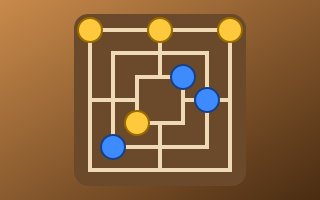 Navakankari
Pallanguzhi: sowing and capturing seeds
Pallanguzhi is a seed-sowing game played in South India, especially in Tamil Nadu and Kerala, and in Sri Lanka. It belongs to the large family of mancala games played in many parts of the world. Traditional boards are wooden with two rows of seven pits, and people play with tamarind seeds, cowrie shells or small stones.
At home, an egg carton with the lid cut off works well, or draw two rows of seven circles on paper. Put 5 seeds in every pit to start; some families use 6. Each player owns the row of seven pits nearest to them.
- On your turn, pick up all the seeds from one pit in your row.
- Going anticlockwise, drop one seed in each pit, starting with the next pit along. Your path goes round both rows.
- When your hand is empty, look at the pit after the one where your last seed fell. If it has seeds, pick them all up and keep sowing.
- If that pit is empty, capture all the seeds in the pit just after it and keep them in your store. Your turn ends. If that next pit is empty too, you capture nothing.
- Many families also play that any pit reaching exactly four seeds during sowing is captured by the owner of that row.
- When a player has no seeds left in their row, the game ends. Each player adds the seeds left in their own row to their store, and the bigger pile wins.
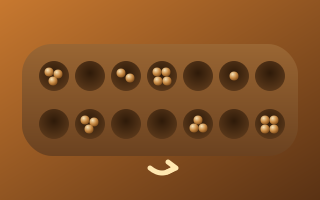 Pallanguzhi
Moksha Patam: the old Snakes and Ladders
Moksha Patam is widely described as the Indian game that later became Snakes and Ladders. Old boards were used to teach ideas about right and wrong: ladders stood for good deeds that lift you up, and snakes for bad habits that pull you down. The final square stood for moksha, or freedom. Older boards came in different sizes, and the 100-square board is the version most people know today.
To make one, draw a 10 by 10 grid on a large sheet and number it from 1 in the bottom left, going left to right on the first row, right to left on the next, and so on up to 100. Draw five or six ladders and the same number of snakes. A fun family activity is to label each ladder with a good habit, such as sharing or telling the truth, and each snake with a bad one.
- Each player rolls one die in turn and moves forward that many squares.
- Land on the foot of a ladder and you climb to its top. Land on a snake's head and you slide down to its tail.
- The first player to reach 100 wins. Many families play that you need the exact number to land on 100.
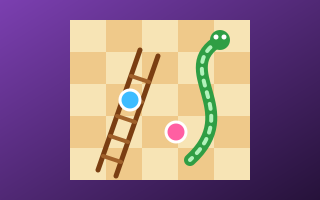 Moksha Patam
Chaturanga: where chess began
Most historians agree that chess began in India around 1,500 years ago as a game called Chaturanga. The name is usually explained as the four limbs of an army: foot soldiers, horses, elephants and chariots. The exact old rules are not fully known, so today people usually learn modern chess and enjoy its Indian roots.
Any 8 by 8 grid drawn on card will do. Early Indian boards were often not chequered, so you do not need to colour the squares. Each side has 8 pawns, 2 rooks, 2 knights, 2 bishops, a queen and a king; coins and buttons with paper labels work fine.
- Rooks move any distance in a straight line along rows or columns. Bishops move any distance diagonally. The queen does both.
- Knights move in an L shape, two squares one way and one to the side, and may jump over pieces.
- The king moves one square in any direction. Pawns move forward one square, or two on their first move, and capture one square diagonally forward.
- You capture by moving onto an opponent's piece. Putting the king under attack is check, and the game is won by checkmate: the king is attacked and has no escape.
- Add castling, en passant and pawn promotion once the basic moves feel easy.
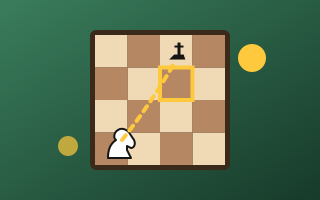 Chaturanga Puzzles
Kolam: patterns around dots
Kolam is not a board game but a daily art. In many homes in South India, especially in Tamil Nadu, a pattern is drawn at the doorstep each morning with rice flour. One well-known style starts with a grid of dots, and lines curve and loop around them to make a balanced design.
To play at home, draw a 5 by 5 grid of chalk dots on the floor or pencil dots on paper. One person draws a pattern in one quarter. The other person completes the rest so that it mirrors across the middle, or turns round the centre like a wheel. Then swap roles. It is a calm way to practise symmetry.
 Kolam Patterns
 Mirror Match