
Guides · 7 min read
Logic puzzle strategies that work on almost any grid
Most logic puzzles look different on the surface, but underneath they are solved with the same small set of habits. Once you know them, a new puzzle type stops feeling like a blank wall. You recognise the shape of the thinking and know where to start.
Below are six techniques, each shown with a GoKith puzzle where it comes up naturally. None of them needs special talent. They are ways of looking, and they get easier every time you use them on purpose.
1. Start from the tightest constraint
Every puzzle has places where the rules squeeze hardest. Find those first. A row with only one empty square, a region with very few cells, a clue that leaves almost no choice: these are where the first certain moves hide.
In Elephant Parade you place one elephant in every row, every column and every colour region, and no two elephants may touch, not even at the corners. Beginners often start in the top-left corner and guess. A better start is the smallest colour region. If a region is only two cells long and both cells sit in the same row, then the elephant for that row must be one of those two cells. Every other cell in that row can be crossed out at once, before you know which of the two is right.
Ask yourself, at the start of any puzzle: where does the puzzle give me the least freedom? Begin there.
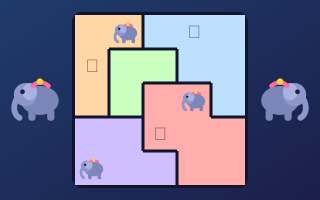 Elephant Parade
2. Eliminate, then look at what is left
Often you cannot see where something goes, but you can see where it cannot go. Cross those places out, and the answer appears in the space that remains.
Sudoku is built on this. Pick a number, say 5, and a box that does not yet have one. Look along every row and column that already contains a 5 and mentally cover those squares. If only one square in the box is left uncovered, the 5 goes there. You did not find the 5 directly. You found every place it could not be.
Pixel Logic has a neat version of the same idea. Suppose a row is 10 squares long and its clue is a single block of 7. Slide the block as far left as it can go, and it covers squares 1 to 7. Slide it as far right as it can go, and it covers squares 4 to 10. Squares 4 to 7 are filled in both positions, so they must be filled whatever happens. Four certain squares from one clue, with no guessing.
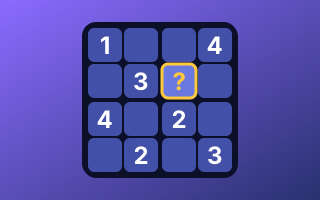 Sudoku
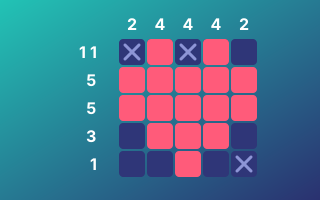 Pixel Logic
3. Look for forced moves
Some patterns force a move the moment you spot them. Learning a puzzle's forced patterns is the biggest single step from beginner to confident solver.
In Diya & Lotus every row and column has equal numbers of diyas and lotuses, and you may never have three of the same in a line. That one rule creates two very useful patterns. If two diyas sit side by side, the squares at each end of the pair must be lotuses. If two diyas have one empty square between them, that middle square must be a lotus. Scan the whole grid for these pairs and gaps before doing anything cleverer.
Kakuro has its own forced patterns. Each run of squares must add up to its clue using the digits 1 to 9 with no repeats. Two squares that add to 3 can only be 1 and 2. Two squares that add to 17 can only be 8 and 9. Learn a handful of these and many puzzles open up quickly.
 Diya & Lotus
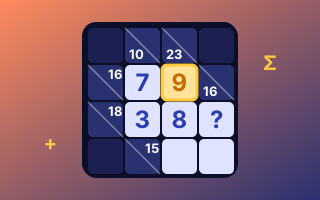 Kakuro
4. Try it, and be ready to undo
Sometimes careful thinking takes you only so far, and you need to test an idea. That is fine, as long as you treat it as an experiment rather than a guess you hope will work.
Make one move, follow its consequences a few steps, and watch for a contradiction. If the experiment breaks a rule, you have learned something certain: that move was wrong, so the other option must be right. Then undo back to the point where you started.
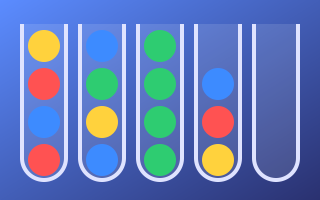
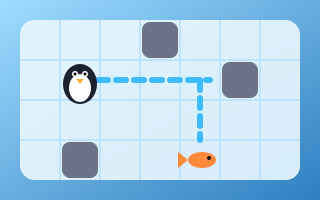
Puzzles where moves are easy to reverse are a good place to practise this. In Lamp Logic each tap flips a lamp and its neighbours, and tapping the same lamp again flips them back, so an experiment costs nothing. In Tube Sort and Ice Slide, trying a short sequence and then stepping back teaches you which early moves block you later.
 Lamp Logic
 Tube Sort
 Ice Slide
5. Work backwards from the goal
When the start of a puzzle offers too many choices, look at the end instead. Ask what must be true just before the puzzle is solved, then what must be true just before that.
Ring Tower is the classic example. You move a tower of rings to another peg, one ring at a time, never putting a bigger ring on a smaller one. Think about the largest ring. To move it, every other ring must be stacked on the third peg, out of the way. So the real first task is to move the smaller tower to that peg. The same reasoning then applies to the smaller tower, and the whole plan unfolds from the end.
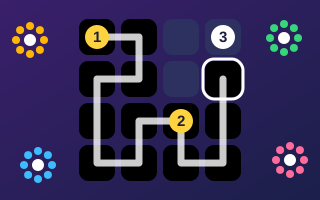
Rangoli Trail, where one line must pass through every square and visit the numbers in order, often yields to the same idea. Look at the last number and ask which squares near it could still be reached at the end of the path. Corners and narrow passages near the finish limit the route sharply.
 Ring Tower
 Rangoli Trail
6. Keep notes, and test cases one at a time
Your memory is a poor place to store a puzzle. Write things down, or use the notes tools the game gives you. Sudoku's pencil marks, the crosses in Elephant Parade and a record of earlier guesses all free your attention for the actual thinking.
Notes also make case-by-case reasoning possible. In Truth Tellers, each islander either always tells the truth or always lies. Pick one person and suppose they are telling the truth. Follow what that means for everyone else. If you reach a contradiction, your supposition was wrong, so that person must be a liar. If not, check the other case too before deciding.
In Code Cracker, keeping a tidy record of each guess and its feedback lets you rule out whole groups of codes at once instead of trying them one by one.
 Truth Tellers
 Code Cracker
When you are stuck
Being stuck is a normal part of every good puzzle. It usually means you have missed one small fact, not that the puzzle is beyond you.
Go through the techniques in order. Check the tightest constraint again, since something may have changed. Scan the whole grid for forced patterns, slowly. Look at each row, column and region and ask what it still needs. If nothing appears, take a short break. Coming back with fresh eyes often shows the move in seconds.
Finally, notice which technique cracked the puzzle when you finish. Naming it, even quietly to yourself, is how a lucky spot becomes a habit you can use next time.