
Guides · 7 min read
How to play Tambola (Housie): rules, prizes and hosting tips
Tambola, also called Housie in many parts of India, is the number game that turns up at birthday parties, festival evenings, kitty parties and school fêtes. One person calls out numbers, everyone else marks them on a ticket, and the first person to complete a pattern shouts to claim a prize.
It is easy to learn, works for any number of players and suits a room where a seven-year-old sits next to a grandmother. This guide explains the rules as they are commonly played, how to run a game yourself and how to keep it fair and friendly. House rules vary from family to family, so treat this as a solid starting point rather than the only correct version.
The Tambola ticket
A standard ticket is a grid of 3 rows and 9 columns, so 27 squares in all. Exactly 15 of those squares hold numbers, and the other 12 are blank. Each row always has 5 numbers and 4 blanks.
The columns follow the tens. The first column holds numbers from 1 to 9, the second from 10 to 19, the third from 20 to 29, and so on. The last column usually holds 80 to 90, so it can contain one extra number. Within a column, numbers go from smallest at the top to largest at the bottom.
Every column has at least one number, and no number appears twice on the same ticket. Because the numbers run from 1 to 90 and each ticket shows only 15 of them, every player has a different set and nobody can predict who will finish first.
- 3 rows, 9 columns, 15 numbers per ticket
- 5 numbers in every row
- Column 1 for 1–9, column 2 for 10–19, up to column 9 for 80–90
- Players mark called numbers with a pen, a dabber or a tap on a phone
Calling the numbers
The caller draws the numbers 1 to 90 one at a time, in a random order, until a full house has been won or all 90 have gone. Traditionally the numbers come from a bag of wooden or plastic counters, or from slips of paper in a bowl. Today many families use a phone or a laptop instead.
Each number is called clearly, often twice, and the caller keeps a record of everything drawn so far. That record matters, because it is how claims are checked later.
Part of the fun is the calls themselves. Many callers give numbers a nickname or a short rhyme. Some are based on what the digits look like, so 88 might be described as two plump figures side by side. Some rhyme with the number, some refer to ages or well-known dates, and many families have private jokes about a favourite uncle's age or a house number. There is no official list. Children enjoy inventing their own calls, which also helps them remember the numbers.
The common prizes
Before the game starts, the caller announces which prizes are on offer. Each prize can be won once, and the first valid claim takes it. If two people claim the same prize on the same number, many groups share it.
These are the patterns you will meet most often:
- Early Five (sometimes called Quick Five or Jaldi Five): the first player to mark any five numbers on the ticket.
- Top Line: all five numbers in the top row are marked.
- Middle Line: all five numbers in the middle row are marked.
- Bottom Line: all five numbers in the bottom row are marked.
- Four Corners: the first and last numbers of the top row and of the bottom row are marked.
- Full House: all 15 numbers on the ticket are marked. This is usually the biggest prize and it ends the game.
Claiming and checking
When a player completes a pattern, they call out straight away, usually by shouting 'Tambola' or 'Housie' and naming the prize. A common rule is that a claim must be made before the next number is called. If you notice it later, the chance has passed.
The caller then checks the ticket against the list of called numbers. If every number in the pattern has been called, the claim is valid and the prize is awarded. If even one number has not been called, the claim is wrong. In many groups this is called a bogey, and the ticket is out for that prize or for the rest of the game. With children it is kinder to give a warning first and a penalty only for a second mistake.
Checking aloud is part of the fairness. Read out each number in the pattern while everyone listens, so nobody feels a prize was handed out carelessly.
How to host a game for family or a class
You can run Tambola with paper tickets and a bowl of numbered slips, but a screen makes the caller's job much easier. With Group Tambola you put the caller screen on a TV, laptop or phone. Players scan a QR code to get their own ticket on a phone, and anyone without a phone can use a printed ticket. The screen shows the called numbers in large type, can read them aloud, and checks a claim when you type in the ticket number.
A simple plan for an evening or a lesson:
- Decide the prizes first. For a short game, Early Five, one line and Full House is plenty.
- Hand out tickets and give everyone a minute to look at theirs.
- Explain the claiming rule out loud, including what happens with a wrong claim.
- Call at a steady pace. Leave a little longer between numbers when young children or older relatives are playing.
- Check every claim aloud against the called numbers.
- Announce winners as you go and keep a short list, so nothing is disputed later.
 Tambola
Fair-play tips
Tambola is pure chance once the tickets are dealt, which is exactly why it works across ages. The skill is in listening and marking accurately, so most fairness questions are about attention, not luck.
Keep prizes small and cheerful: a star, a sweet, first choice of the next game or the right to be the next caller. Large prizes tend to make the mood tense, and children who lose feel it more. If the same person wins twice, some families let them sit out the next prize so others get a turn.
Pair very young players with an older partner who helps them find numbers, but let the child do the marking and the shouting. For a classroom, let pupils take turns as caller once they know the game. Reading numbers clearly to a room is a good job for a confident child.
- Agree all rules, including the bogey rule, before the first call
- Never call faster than the slowest player can mark
- Keep the called-numbers board visible to everyone
- Settle disputes by checking the record, not by who shouts loudest
Variations and practice
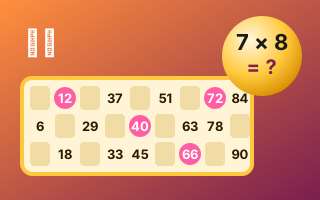
Once the basic game feels easy, try a maths version. Instead of calling 56, the caller says '7 times 8' or 'half of 112', and players work out the number before they can mark it. The host screen can give these maths clues for you, with a choice of difficulty, so the whole room practises mental arithmetic without it feeling like homework.
If you want to practise alone first, the solo Tambola game lets you play against friendly computer players, with plain calls at your own pace or harder levels with maths clues. It is a gentle way to learn the patterns before hosting a real game.
 Vedic Maths Tricks