
Guides · 7 min read
Maths games at home: number sense, mental maths and patterns
Maths at home does not need worksheets. Numbers are everywhere: in recipes, prices, bus timings, cricket scores and the steps up to your front door. When children use numbers for something real, or as part of a game, they get a chance to practise without the feeling of being tested.
This guide has ideas for everyday maths games in the kitchen, at the shops and while travelling, a few GoKith games that fit well, and a careful explanation of some popular mental-maths shortcuts, with worked examples and the reason each one works.
What number sense means
Number sense is a feel for how numbers behave. A child with good number sense knows that 49 is close to 50, that 8 + 7 is the same as 10 + 5, and that half of 30 must be less than 30. It is less about remembering rules and more about seeing connections.
Games are a natural way to practise it, because they ask for estimating, comparing and trying different routes to the same answer. Many children around 7 to 9 are ready for quick adding and subtracting games, while older children and adults enjoy puzzles that mix all four operations.
In the kitchen
Cooking is full of numbers, and children usually enjoy being trusted with a real task.
- Double or halve a recipe. If a recipe uses 3 cups of flour for 4 people, how much for 8? How much for 2?
- Count in groups. How many rotis for the family if each person eats 3? How many plates are left if 4 are already on the table?
- Estimate first. Guess how many peas are in a handful, then count them in fives.
- Tell the time. If dal takes 25 minutes and it is 6:40 now, when will it be ready?
- Share fairly. Cut a pizza or a cake so that 3 people get equal shares. What fraction does each person get?
Shopping and travel
Shopping and journeys give natural reasons to add, subtract and estimate.
- Round and add. Before you reach the till, ask your child to round each price to the nearest ten and add them up. Then compare with the real bill.
- Change game. If the total is 136 rupees and you pay with 200, how much change should come back? Counting up from 136 to 140, then to 200, is often easier than subtracting.
- Best buy. Is one packet of 500 g better value than two packets of 250 g at a different price?
- Number plates. On a journey, add the digits of a number plate, or try to make 10 from its digits using any operations.
- Distance and time. If a train covers about 60 km in an hour, roughly how long for 150 km?
GoKith games for numbers and patterns
Hit the Number gives you a set of numbers and a target. Combine two at a time with add, subtract, multiply or divide until you reach the target exactly. There is often more than one way, so it is a good one to compare routes with someone else.
Number Pyramid asks you to fill in bricks where each one is the sum of the two below. It practises adding upwards and subtracting downwards, and every pyramid can be solved by logic alone. Magic Square and Kakuro take adding further, with every line needing to reach a set total.
For patterns, What's Next? shows sequences of numbers and shapes with a hidden rule. Balance Scale uses balanced scales to work out the weight of a mystery shape, which is the kind of thinking that sits behind early algebra. You can find more in the Math category.
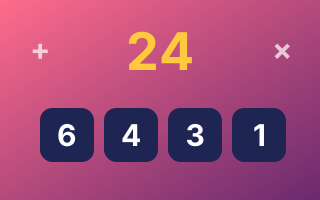 Hit the Number
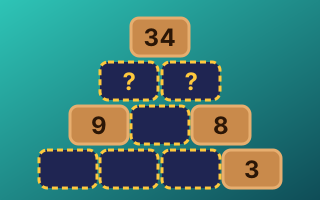 Number Pyramid
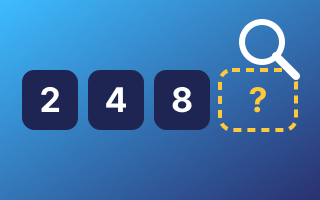 What's Next?
Vedic-maths-style shortcuts, explained
Vedic maths is the name of a set of mental arithmetic methods made popular by a book by Bharati Krishna Tirtha, published in the 1960s. The methods are clever and useful, though how closely they connect to the ancient Vedas is debated. The best way to use them is to understand why they work, so they become real understanding rather than magic tricks. Here are five, each with a worked example.
Multiplying a two-digit number by 11. Write the first digit, then the sum of the two digits, then the last digit. For 43 × 11: 4, then 4 + 3 = 7, then 3, giving 473. If the middle sum is 10 or more, carry the 1. For 68 × 11: 6 + 8 = 14, so write 4 in the middle and add 1 to the 6, giving 748. It works because 11 = 10 + 1, so 43 × 11 = 430 + 43.
Squaring a number that ends in 5. Multiply the first part by the next number up, then write 25 after it. For 35²: 3 × 4 = 12, then 25, giving 1225. For 85²: 8 × 9 = 72, giving 7225. It works because a number ending in 5 squared always ends in 25, and the rest comes to the first part times one more than itself.
Multiplying numbers just below 100. For 97 × 96, note how far each is below 100: 3 and 4. Take either number minus the other's gap: 97 − 4 = 93, which is the same as 96 − 3. Then multiply the gaps: 3 × 4 = 12. Put them together to get 9312. If the product of the gaps is a single digit, write it with a 0 in front, so 98 × 97 gives 95 and 06, or 9506.
Subtracting from 1000. Take every digit from 9 and the last digit from 10. For 1000 − 357: 9 − 3 = 6, 9 − 5 = 4, 10 − 7 = 3, giving 643. You can check by adding: 357 + 643 = 1000. This works for numbers that do not end in 0.
Vertically and crosswise for two-digit numbers. For 23 × 41, first multiply the units: 3 × 1 = 3. Then cross-multiply and add: 2 × 1 + 3 × 4 = 14, so write 4 and carry 1. Finally multiply the tens: 2 × 4 = 8, plus the carried 1 makes 9. The answer is 943. This is the same as long multiplication, just done in a different order in your head.
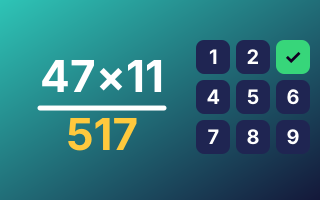 Vedic Maths Tricks
Keeping it playful
Maths games work best when nobody feels rushed or judged. A few habits help.
- Ask how, not just what. Hearing a child explain their method shows you how they think, and it often reveals a clever route you had not considered.
- Allow fingers, paper and pauses. Speed comes later, if at all, and it is not the goal.
- Celebrate good estimates, not only exact answers.
- Play maths games as a family, such as Moksha Patam, where a correct answer earns a better roll, or a round of Tambola, where everyone listens for numbers.
- Keep sessions short and stop on a success.